No Guns? No Problem.
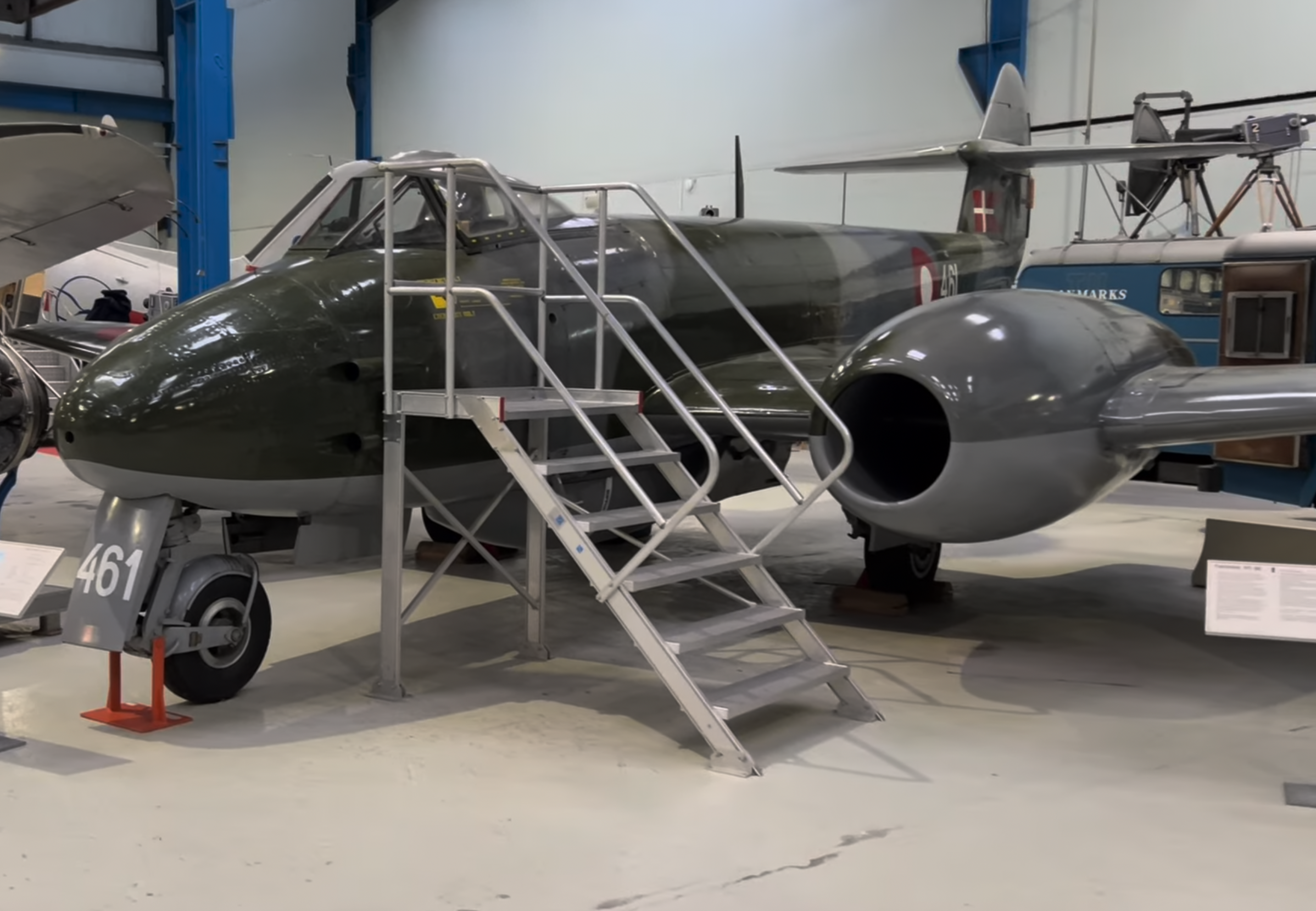
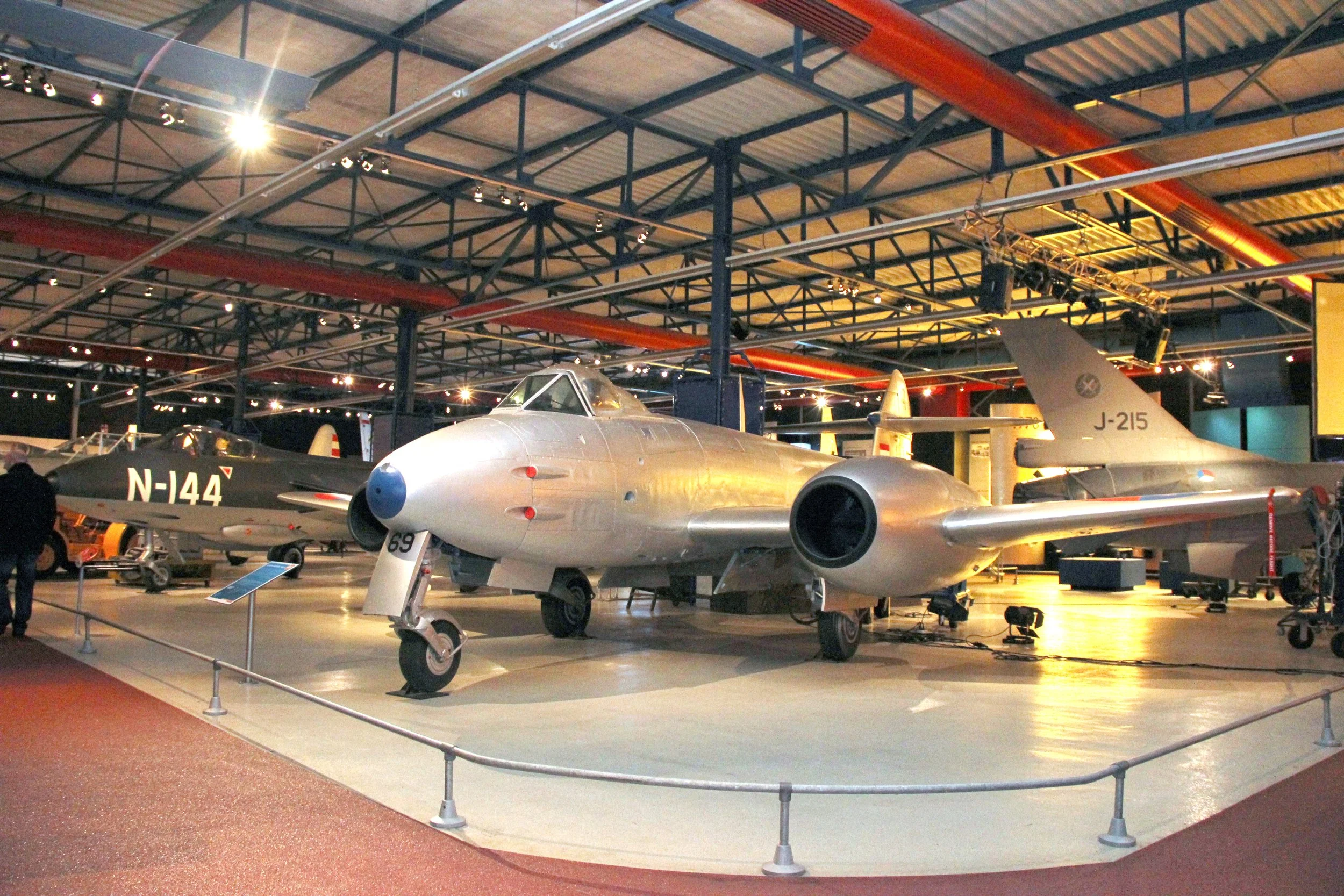
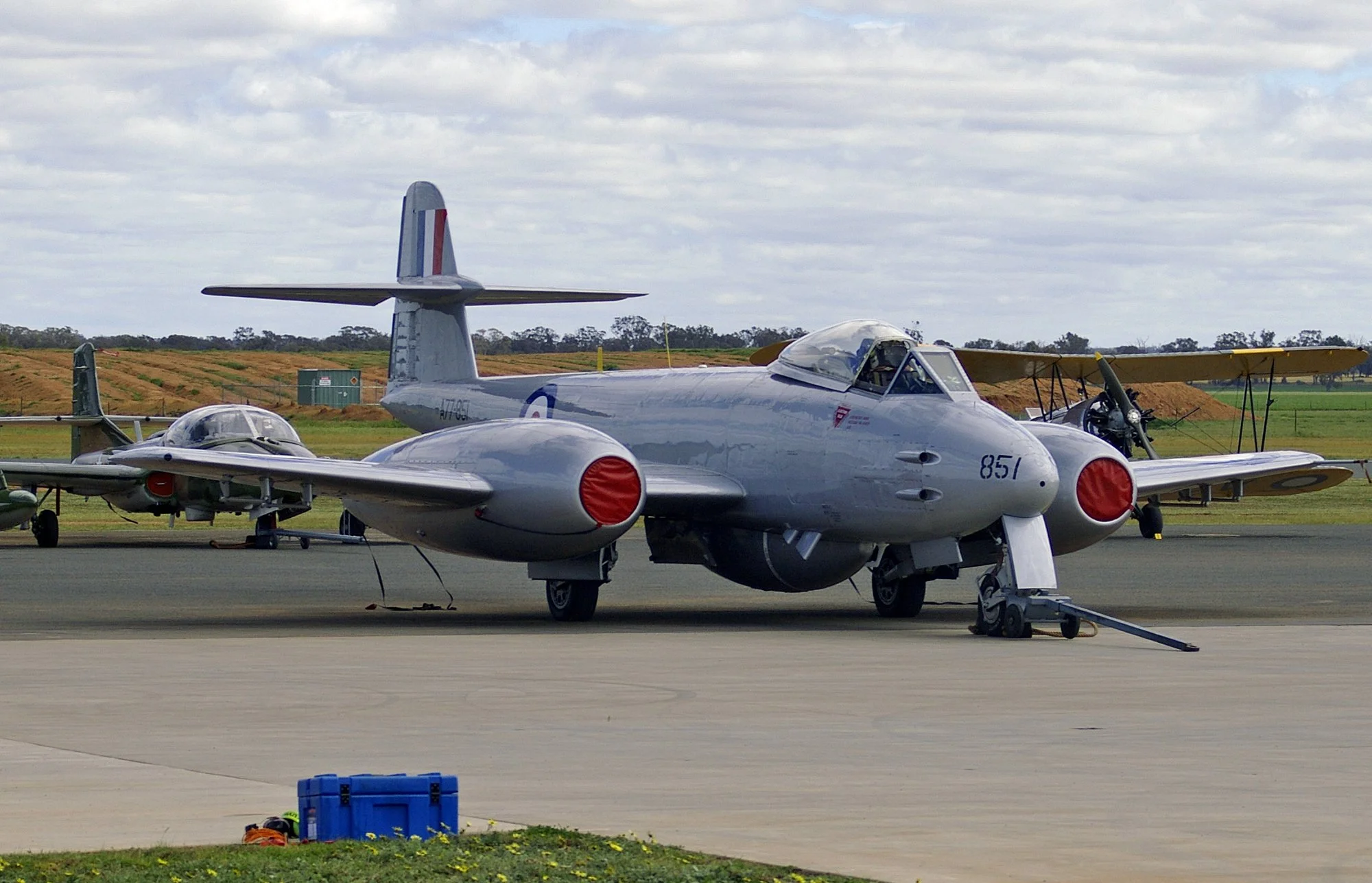
The Gloster Meteor destroyed its first enemy without firing a single shot — and that was just the beginning of a very strange, very British story
There is a moment in August 1944 that perfectly snaphots everything strange and wonderful about the earliest days of jet aviation. A brand-new British jet fighter — the most secret aircraft in the Royal Air Force, an aircraft so classified its pilots were forbidden from flying over enemy territory in case one was shot down and the technology examined — is chasing a German flying bomb over the English countryside.
The pilot, Flying Officer "Dixie" Dean of No. 616 Squadron, closes in. He squeezes the trigger. Four 20mm cannons, enough firepower to tear apart any aircraft of the era.
Nothing. Guns jammed. Silence.
A less inventive man might have broken off the intercept attempts. Dean did not. He pushed the throttle forward, closed the distance, drew up alongside the V-1 until his wingtip was centimetres from the flying bomb's wingtip, and then — with an almost comedic delicacy — gave it a nudge.
The air pressure between the two wings was enough to topple the V-1's gyroscope. The bomb pitched over and ploughed into a field below. Dean pulled away clean.
The Gloster Meteor had scored its first kill. It had done so without firing a shot. And nobody outside a very small circle of RAF officers was allowed to know about it.
The Man Behind the Engine
To understand the Meteor, you have to understand Frank Whittle — a man who spent most of the 1930s being told, with great confidence, that he was wrong.
Whittle, a young RAF officer with an engineer's mind and a prophet's stubbornness, had been developing the concept of a jet turbine engine since 1929. The principle was straightforward: instead of using pistons and propellers to push an aircraft through the air, you compress air, mix it with fuel, ignite it, and blast the exhaust backwards. Action, reaction. Newton's third law applied to aviation.
The Air Ministry largely ignored him. Private investors were sceptical. Whittle pressed on anyway, funding research through a small private company called Power Jets Ltd. By 1937, he had a running engine on a test bench. By 1939, with war looming and Germany clearly ahead on several fronts, the establishment finally noticed.
Gloster Aircraft Company were handed the contract to build an airframe around Whittle's engine. The result, after years of development, prototype testing, and the kind of engineering chaos that attends all genuinely new technology, was the Gloster Meteor — Britain's first jet fighter, and the only Allied jet aircraft to see combat in the Second World War.
What the Meteor Actually Was
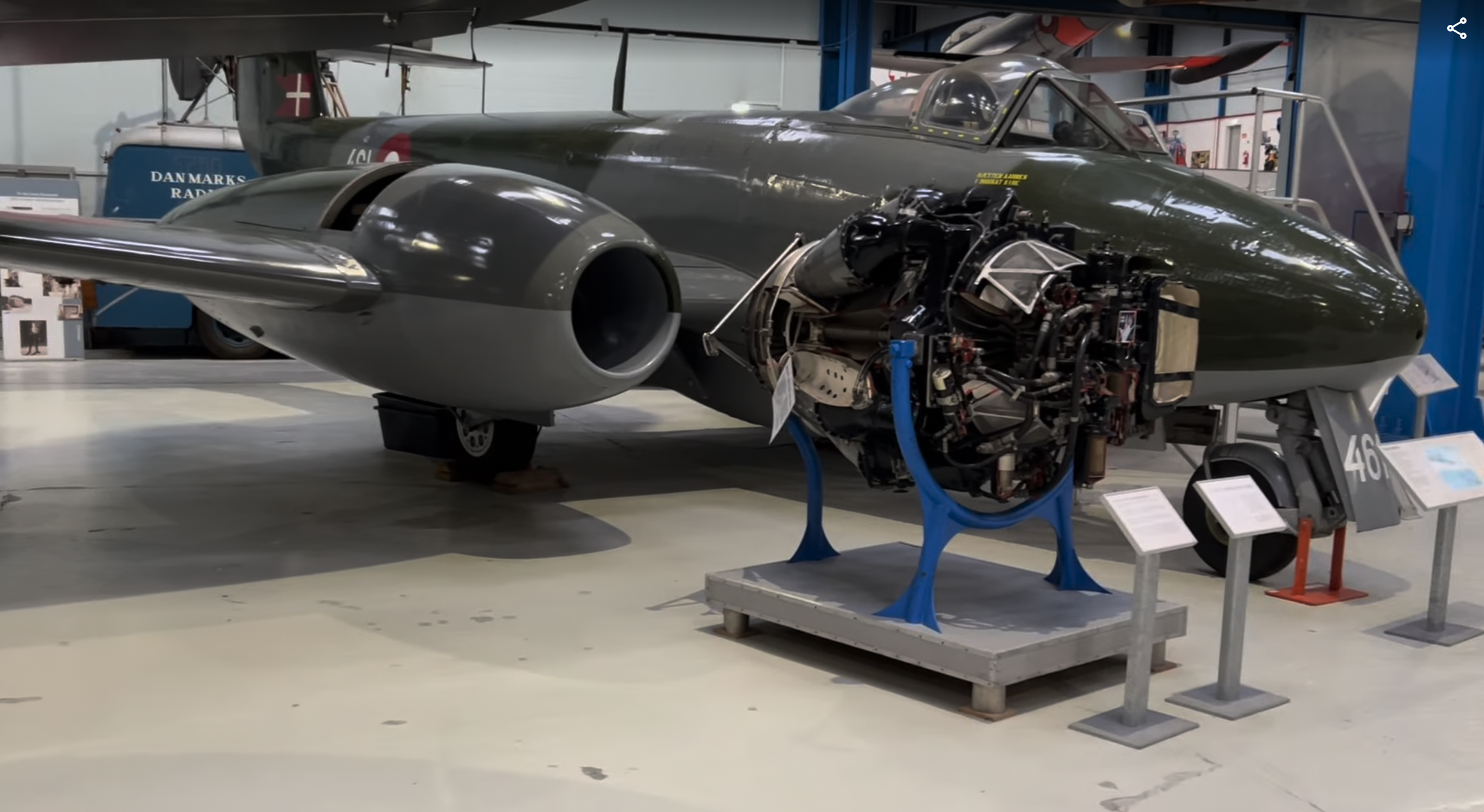
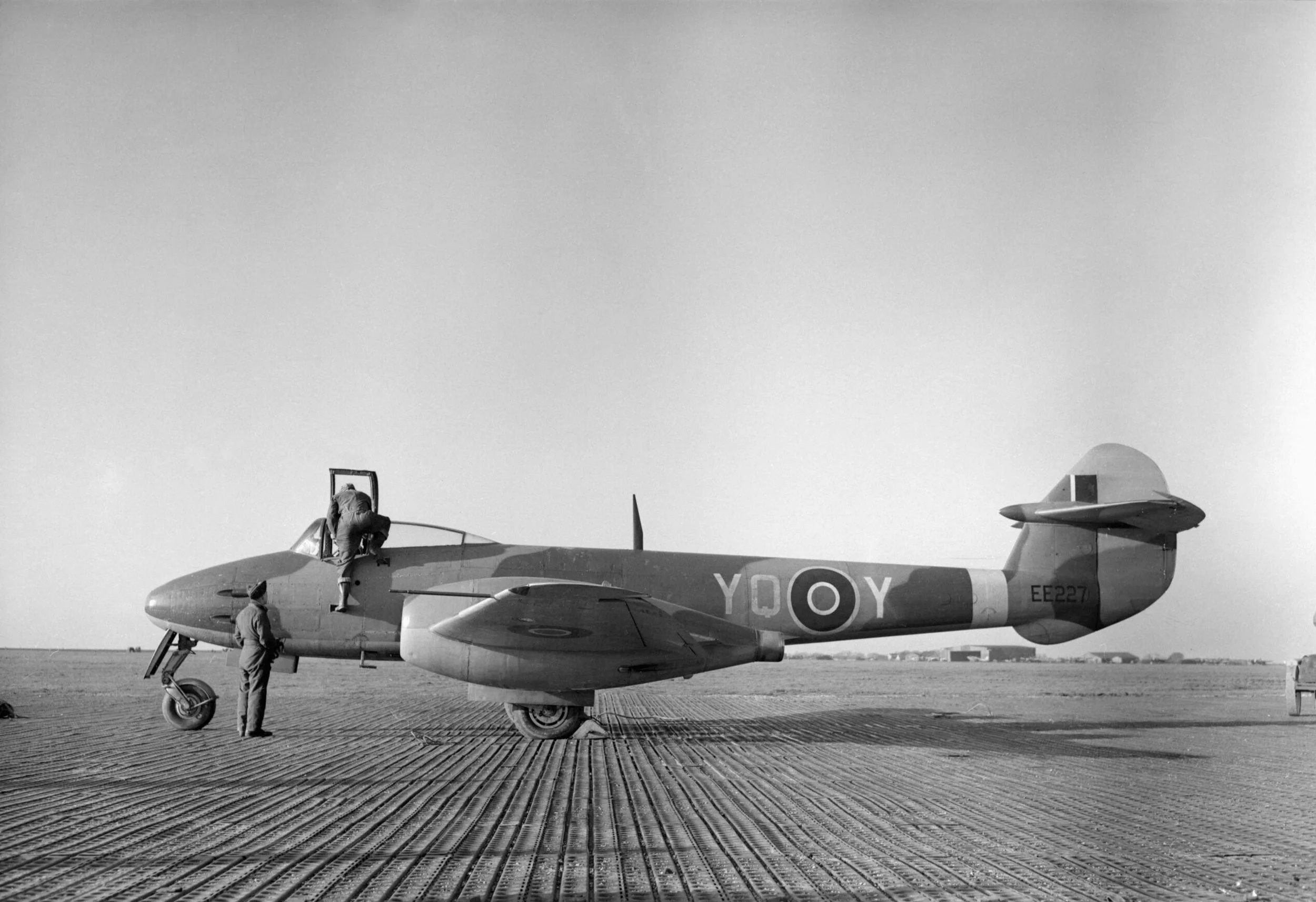
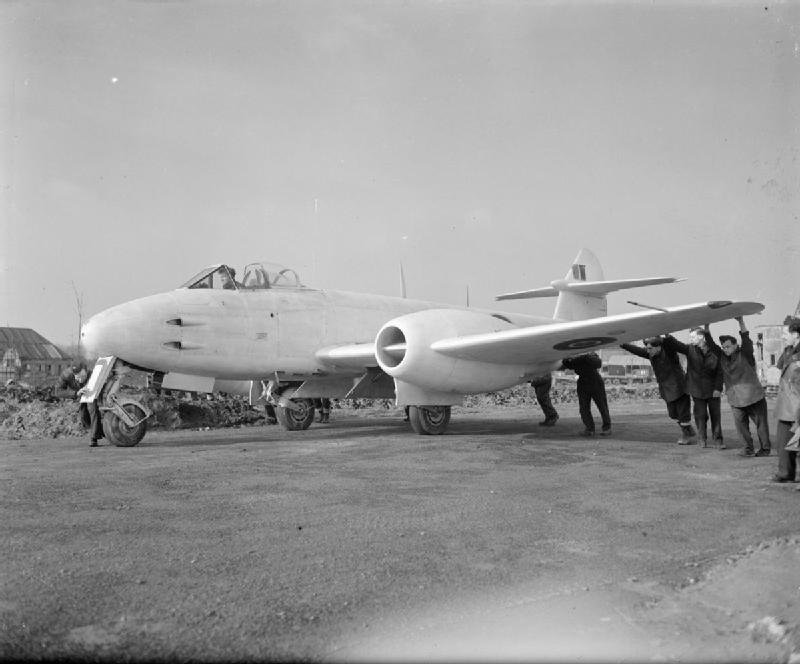
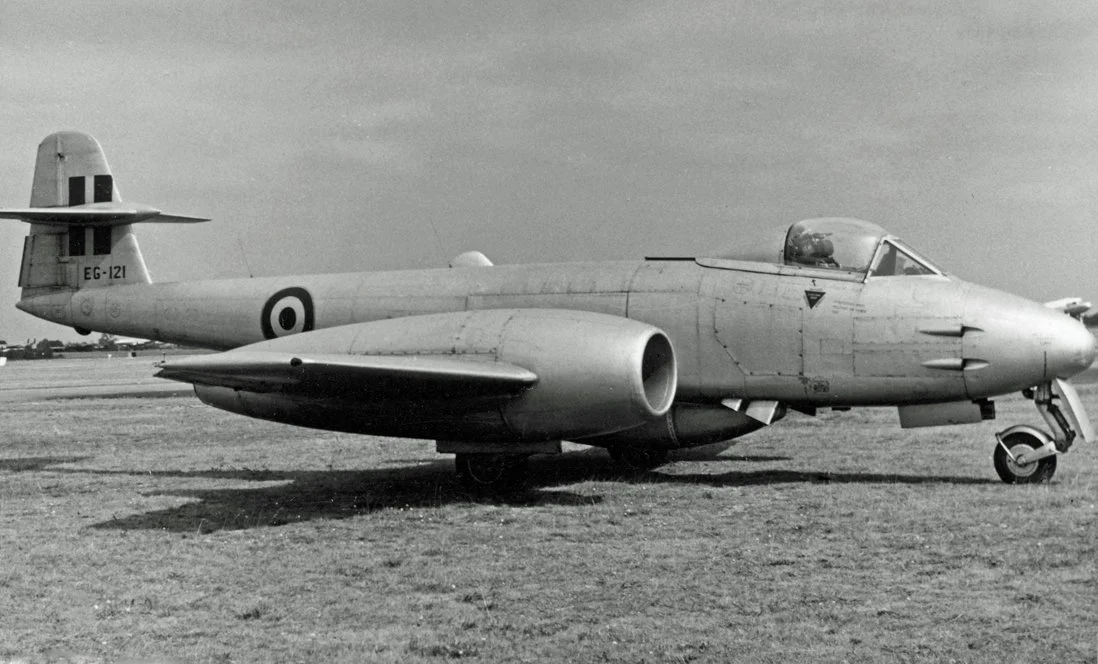
Let's be honest about something: the Meteor was not, aerodynamically speaking, a beautiful aircraft. Where the German Me 262 — its direct rival, developed in parallel — had swept wings and a rakish, menacing silhouette, the Meteor looked like someone had taken a conventional piston-engine fighter, removed the propellers, and bolted two engine nacelles onto the wings. Which is, more or less, what Gloster had done.
The first production variant, the F.Mk.I, was a straight-winged, twin-engined machine of solid, reassuring Britishness. It wasn't trying to win a beauty contest. It was trying to get into the air as fast as possible, with the most reliable engine Whittle's team could produce.
That engine was the Rolls-Royce Welland — a centrifugal-flow turbojet producing 1,700 lbs of thrust per unit. Two of them gave the early Meteor a top speed of around 410 mph at sea level, making it marginally faster than the best piston-engine fighters of the day, and significantly faster at the low and medium altitudes where the V-1 flying bombs operated.
The Meteor entered service with No. 616 Squadron on 27 July 1944. The technology was so closely guarded that pilots were not allowed to fly over enemy lines, for fear of the aircraft falling into German hands. This had an almost farcical consequence: Britain and Germany each had operational jet fighters that were theoretically the most advanced combat aircraft in existence, and neither side's jet ever met the other's in the air. The first jet-vs-jet aerial combat would have to wait for Korea.
The Numbers (For Those Who Like Numbers)
The Meteor evolved rapidly across its service life, and the specifications tell the story of that evolution better than anything else.
Meteor F.Mk.I (1944)
Engines: Two Rolls-Royce Welland I turbojets, 1,700 lb thrust each
Max speed: 410 mph (660 km/h) at sea level
Service ceiling: 40,000 ft (12,200 m)
Armament: Four 20mm Hispano cannons
Meteor F.Mk.3 (1945)
Engines: Two Rolls-Royce Derwent I turbojets, 2,000 lb thrust each
Max speed: 493 mph (794 km/h) — faster than any piston-engine fighter in the world
Range: 1,340 miles (2,155 km) with drop tanks
New: Sliding canopy replacing the original hinged type; longer engine nacelles for cleaner airflow
Meteor F.Mk.8 (the definitive variant, from 1950)
Engines: Two Rolls-Royce Derwent 8 turbojets, 3,600 lb thrust each — more than double the thrust of the original Welland
Max speed: Mach 0.82 — approximately 600 mph (965 km/h)
Service ceiling: 43,000 ft (13,100 m)
Rate of climb: 7,000 ft/min — reaching 30,000 ft in just five minutes
Range: 520 nautical miles (960 km)
Armament: Four 20mm Hispano Mk V cannons, plus provision for sixteen RP-3 rockets or two 1,000 lb bombs
The jump from the F.1 to the F.8 is extraordinary: roughly 50% more speed, more than double the thrust, dramatically improved climb rate, and a pressurised cockpit as standard. All in six years of development, during which jet aviation went from theoretical curiosity to the backbone of every major air force in the world.
The Speed Records
In November 1945, three months after the war ended, a Meteor F.Mk.3 took off from a measured course along the Thames Estuary with one specific mission: go as fast as possible.
Group Captain H.J. Wilson reached 606 miles per hour, setting the world's first official airspeed record by a jet aircraft. The following year, a Meteor F.Mk.4 pushed that to 616 mph. The jet age had a benchmark.
But the speed records were almost beside the point compared to a stranger, quieter achievement: on 20 September 1945, a modified Meteor fitted with two Rolls-Royce Trent engines driving conventional propellers became the first turboprop aircraft in history to fly. A jet fighter, converted into a propeller aircraft, demonstrating an entirely different category of engine technology. The Meteor was so mechanically adaptable that engineers used it as a flying test bed for whatever they wanted to try next.
It also became, in 1946, the first jet aircraft to receive civilian registration — a small but telling milestone. The future had arrived, and it was being processed by the same bureaucracies that handled everything else.
"Dixie" Dean and the Art of Improvisation
Back to that August afternoon in 1944, because the wingtip story deserves more attention than it usually gets.
When Flying Officer Dean's guns jammed, he used the Meteor's speed advantage to draw alongside the V-1 and tip it with his wing, throwing off the gyrocompass that the bomb used to maintain level flight. This required closing to within arm's reach of a weapon carrying an 1,870-pound warhead, travelling at over 400 mph, above the English countryside.
In total, Meteor F.1s destroyed 14 V-1s during the anti-Diver campaign. Most of those kills were achieved the conventional way, with cannons. But the first one — the one that opened the account, the one that proved the aircraft worked in combat — was achieved by a pilot who ran out of other options and improvised.
It is, in retrospect, an almost perfect metaphor for the entire jet age: brand new technology, untested procedures, and pilots making it up as they went.
A Long Life and a Wider World
The Meteor served with the RAF until 1961 — seventeen years of front-line service, from the last months of the Second World War through the Korean conflict and into the missile age. The Royal Australian Air Force flew Meteors in Korea, while Argentina, Egypt, Israel and several other nations also operated the type in regional conflicts. More than 3,900 were built in total, serving with at least fifteen air forces worldwide.
By the time the Meteor was finally retired, it had become something the prototype engineers could never have imagined: ordinary. Not in a diminishing sense, but in the way that genuinely transformative technology eventually becomes part of the furniture. The twin-jet layout, the swept-back nacelles, the pressurised cockpit, the cannon armament — all of it became standard. The Meteor didn't just introduce Britain to the jet age. It wrote the first draft of what a jet fighter was supposed to look like.
Frank Whittle received a knighthood in 1948. He reportedly felt it came rather late.
A Note on the One That Got Away
History has a habit of pairing the Meteor with its great German rival, the Me 262, and asking a question that can never quite be answered: what would have happened if they'd met? Both were operational in the summer and autumn of 1944. Both were twin-jet fighters with four-cannon armament. The Me 262 was faster in level flight; the Meteor was more reliable in service and ultimately more developed over its lifespan.
They never found out. Security on both sides kept them apart. The dogfight that every aviation enthusiast has imagined exists only in the mind.
Which makes it, perhaps inevitably, a perfect subject for a painting.
Technical Specifications — Gloster Meteor F.Mk.8
Manufacturer
Gloster Aircraft Company
First flight (prototype)
5 March 1943
Service entry
July 1944 (F.Mk.I)
Engines
2× Rolls-Royce Derwent 8 turbojets
Thrust
3,600 lb (16.0 kN) each
Max speed
Mach 0.82 / 600 mph (965 km/h)
Service ceiling
43,000 ft (13,100 m)
Rate of climb
7,000 ft/min (35.6 m/s)
Range
520 nm / 965 km
Armament
4× 20mm Hispano Mk V cannon + rockets/bombs
Total built
3,947 across all variants
Final RAF retirement
1961
Valentyn Kryvorot is a Ukrainian aviation artist whose hand-drawn aircraft illustrations are available as prints, posters, and custom merch. Browse the collection at valentynkryvorot.com